
Meditation brings wisdom; lack of meditation leaves ignorance. Know well what leads you forward and what hold you back, and choose the path that leads to wisdom.
~Buddha
~Buddha
 By MARIA SUDEKUM FISHER,
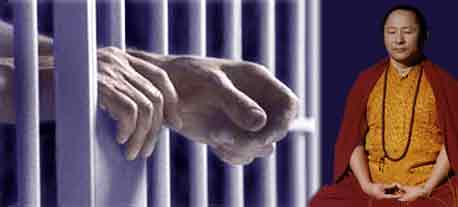
NEWTON, Kansas (USA) -- Tony Farnan's back tells a story. "White Trash" is tattooed across the lower portion. A handcuffed, clenched fist with lightning bolts and a swastika takes up much of the middle. Farnan got the tattoos when he was younger, doing drugs, picking fights and living up to his identity as a pretty rough racist.
But now "White Trash" is covered up with another tattoo, a large purple lotus blossom. The clenched fist has been turned into a great big foo dog, the mythical Chinese protector of sacred places. If you look hard enough, you can make out the fist. But you have to know it's there.
He now takes care of his 95-year-old grandfather at their farmhouse outside Newton. He has sworn off drugs, violence and anything else that helped land him in jail. He's no longer racist.Farnan owes this new life to a discovery he made in prison.
"Buddhism has basically saved my life," Farnan says.
Farnan is one of a growing number of people who have discovered Buddhism while behind bars, thanks in part to the popularity of the religion nationwide and to the scores of Buddhist volunteers heading into prisons to tend to inmates, male and female, who were raised Buddhist or those who discovered the ancient religion later.
Several organizations nationwide now serve Buddhist inmates. The Prison Dharma Network in Boulder, Colo., gives yoga and meditation classes to inmates and also sends books and correspondence to prisoners across the country. The Buddhist Peace Fellowship in Berkeley, Calif., has meditation, yoga, and journal writing programs in several California prisons. The National Buddhist Prison Sangha in Mt. Tremper, N.Y., has been supporting prison inmates with visits and letters since 1984.
He [Farnan] got books on Buddhism, which gave him some guidelines. But months later after he had been sent to the Norton Correctional Facility, Farnan needed a teacher. He looked for a Buddhist session - or callout as it is referred to in prison. Norton didn't have one, so Farnan got by with his books and meditation.
Then he was moved to the Lansing Correctional Facility, where a Buddhist group had been meeting regularly.
"I wasn't looking for a religion. I was looking for some direction and something that could help guide me."
The callouts helped. But for the most part Farnan did "a lot of deep meditation and thinking," trying to keep things simple.
"I don't know, it was probably 2002, early 2003, when I really understood that compassion was kind of the answer.
He started curbing his impulses, too. If another inmate was playing music too loud, the old Farnan would have gone over, picked up the radio and smashed it.
"Now I realized that everyone is suffering, and he's probably playing the music loud to ease his suffering. I still might ask him to lower the volume. But I wouldn't smash it."
James: I would love to volunteer with a program bringing the Dharma to prisoners. They mentioned a group here in Colorado that does such a thing and so I might look them up and see how I could help. If nothing else I can donate some of the Buddhist books that I've read to the program.
It is time that we really institute adequate rehabilitation in the prisons across the world. Bringing spirituality and teaching meditation to those who are suffering in prison is a great way to help others help themselves. There is no way that we can hope to reform prisoners with out addressing their suffering first. Punishing violence and hatred with more violence and hatred doesn't help anyone. Which reminds me of a bumper sticker I saw once about the death penalty. It went something like, "Why do we kill people to show other people that killing is wrong?"
The ideal goal is sending prisoners to prison to learn to change their view of the world and their way of thinking and thus their way of acting. The easiest way that I know how to do that is through mindfulness/awareness and meditation. Prisons, however, don't do much of anything to help them confront and change their habit energy and so they simply revert back to what they know and end up coming out of prison a smarter, better criminal!!
Everyone deserves our compassion.
~Peace to all beings~


 One of the most difficult things to learn is that mindfulness is not dependent on any emotional or mental state. We have certain images of meditation. Meditation is something done in quiet caves by tranquil people who move slowly. Those are training conditions. They are set up to foster concentration and to learn the skill of mindfulness. Once you have learned that skill, however, you can dispense with the training restrictions, and you should. You don't need to move at a snail's pace to be mindful. You don't even need to be calm. You can be mindful while solving problems in intensive calculus. You can be mindful in the middle of a football scrimmage. You can be mindful in the midst of a raging fury. Mental and physical activities are no bar to mindfulness. If you find your mind extremely active, then simply observe the nature and degree of that activity. It is just a part of the passing show within.

 These are in no particular order:

 Today I was running errands and the traffic was pretty hectic being the day before Thanksgiving and all. I was getting a little anxious and caught up in the stress when I remembered to breathe. Then things shifted into focus. I started actually being in the moment rather then be carried off in the moment and I saw things in a more mindful, interconnected way.







 So I've lit some candles, pulled the front shades closed and am listening to my favorite "comfort music/musician" (and favorite music/musician of all time) the Great Prophet Bob Marley. His mystical music has some magic in it that lifts up my mood no matter what state it might be in at the time.
 His musical Enlightenment shines forth as sun rays beaming through parting clouds to touch the precious hearts of untold numbers.


 Picture of "James" taken with the new camera in the black and white function.
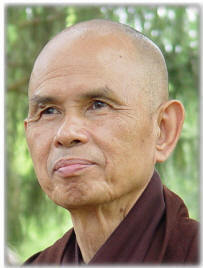
 My lovely wife just bought me a new digital camera for my up-coming birthday and one of my favorite features available is the ability to take black and white pictures. This is a black and white picture that I took of my photo of Thay (as Thich Nhat Hanh is known by his students) on our altar. The beads wrapped around the picture are of my old 108 bead mala.


 Wow, it's been a week since I posted?!! Sorry about that dear friends.


